A Different Inequality by Diane Austin-Broos
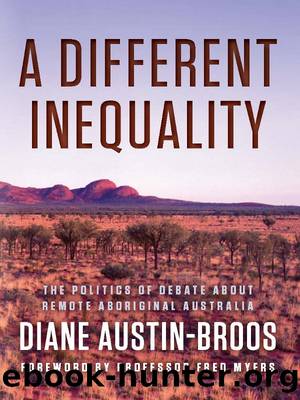
Author:Diane Austin-Broos
Language: eng
Format: epub
Tags: ebook, SOC008000
ISBN: 9781742694528
Publisher: Allen & Unwin Pty Ltd
Published: 2011-07-26T16:00:00+00:00
5
Defending the homelands
Given the degree to which Aboriginal employment problems are intractable, the pursuit of statistical equality is, we believe, both inappropriate and likely to fail.
Jon Altman and Will Sanders, Government Initiatives for
Aboriginal Employment: Equity, equality and policy realism
In Australia, different social science disciplines have framed [the ‘problem’ at the] heart of Indigenous affairs policy in different ways and correspondingly have put forward different policy proposals. For instance, whereas anthropology dwells on cultural difference and presumes that difference to be a social good, economics dwells on socioeconomic inequality and presumes that difference to be the legacy of historical exclusion . . . The [latter] emphasises the need for socioeconomic equality, the [former] sees potential incompatibility between such a policy goal and Indigenous cultural differences and choice.
Jon Altman and Tim Rowse, Indigenous Affairs
In 1990, the Centre for Aboriginal Economic Policy Research (CAEPR) was established as a response to Aboriginal issues, including those that faced the homelands. CAEPR was located at the Australian National University (ANU), which would soon have the largest concentration of researchers on Indigenous Australia in the society or overseas. Anthropologist Jon Altman was the source of inspiration for the centre; he directed it, recruited staff, and attracted diverse funding. The centre had a dual role as a policy research group and as consultant to organisations, both government and non-government. In the course of ATSIC’s life, CAEPR was a crucial, autonomous resource. A published overview of CAEPR’s work underlined the broad scope of its research on social and economic policy issues (see Rowse 2002). The CAEPR group was interdisciplinary and included academics trained in social policy, demography and economics. Others had at least one degree in anthropology. In his role, Altman drew on a first degree in economics and field experience as an economic anthropologist in northern Arnhem Land.1 From time to time, he also worked in association with Tim Rowse, a former Australian Studies fellow at Harvard, biographer of H.C. Coombs, and advocate for the Indigenous sector.2 Rowse’s training was in political science and anthropology, and there is a strong historical bent to his writing (e.g. Rowse 1998a).
In his CAEPR-related work, Rowse saw the Indigenous sector not merely as an administrative vehicle but also as a political vanguard. Consequently, he valued the Indigenous sector most for its role in building ‘legal and political capacities’ (Rowse 2002:231, 2001, 2005). By contrast, Altman was more concerned with remote and very remote Aboriginal employment. He supported CDEP as policy ‘realism’ for remote communities. As noted in Chapter 4, he took this position in response to the Hawke federal government’s Aboriginal Employment Development Project (AEDP 1986/87). Altman stated his position in the course of an Academy of the Social Sciences in Australia (ASSA) workshop on Aboriginal employment equity (see Australia 1987a; Altman 1991). In contrast to the neoliberal view, Altman and his CAEPR colleagues thought that remote Aboriginal communities would require major federal government support for the foreseeable future.3
This chapter discusses writing from the CAEPR group in the main. Throughout, the intention
Download
This site does not store any files on its server. We only index and link to content provided by other sites. Please contact the content providers to delete copyright contents if any and email us, we'll remove relevant links or contents immediately.
| Anthropology | Archaeology |
| Philosophy | Politics & Government |
| Social Sciences | Sociology |
| Women's Studies |
Cecilia; Or, Memoirs of an Heiress — Volume 1 by Fanny Burney(32558)
The Great Music City by Andrea Baker(32019)
Cecilia; Or, Memoirs of an Heiress — Volume 2 by Fanny Burney(31956)
Cecilia; Or, Memoirs of an Heiress — Volume 3 by Fanny Burney(31942)
We're Going to Need More Wine by Gabrielle Union(19046)
All the Missing Girls by Megan Miranda(16027)
Pimp by Iceberg Slim(14507)
For the Love of Europe by Rick Steves(14121)
Bombshells: Glamour Girls of a Lifetime by Sullivan Steve(14075)
Talking to Strangers by Malcolm Gladwell(13370)
Norse Mythology by Gaiman Neil(13365)
Fifty Shades Freed by E L James(13241)
Mindhunter: Inside the FBI's Elite Serial Crime Unit by John E. Douglas & Mark Olshaker(9343)
Crazy Rich Asians by Kevin Kwan(9292)
The Lost Art of Listening by Michael P. Nichols(7506)
Enlightenment Now: The Case for Reason, Science, Humanism, and Progress by Steven Pinker(7313)
The Four Agreements by Don Miguel Ruiz(6765)
Bad Blood by John Carreyrou(6621)
Weapons of Math Destruction by Cathy O'Neil(6280)
